
Telitacicept for immunoglobulin A nephropathy
 Fact-checked by
What is telitacicept for IgAN?
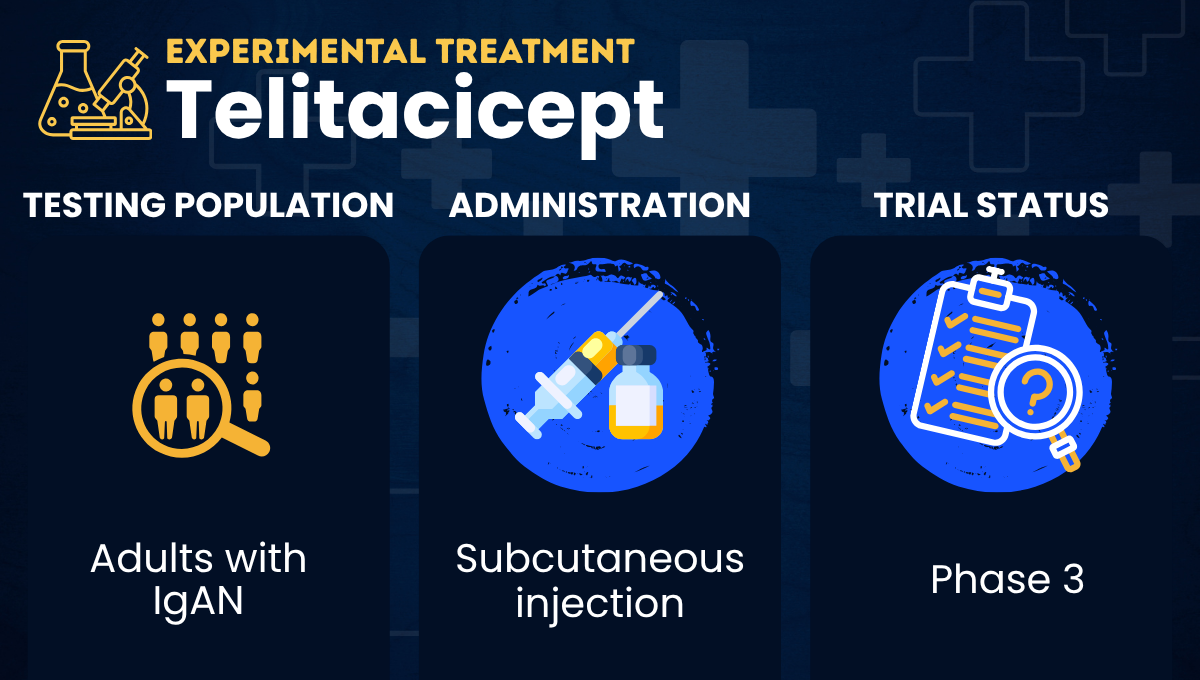
Telitacicept is an injectable therapy being developed for immunoglobulin A nephropathy (IgAN). The drug is conditionally approved in China for treating adults with IgAN who are at risk of disease progression, though it remains investigational in the U.S.
In IgAN, the body produces an abnormal antibody called galactose-deficient immunoglobulin A1 (Gd-IgA1), which forms immune complexes that accumulate in the kidneys, triggering inflammation and damage. Signs and symptoms of IgAN, including excessive protein in the urine (proteinuria), result from declining kidney function.
The signaling molecules A proliferation-inducing ligand (APRIL) and B-cell activating factor (BAFF) may contribute to Gd-IgA1 production by supporting the survival and activation of plasma cells, the immune cells responsible for producing the abnormal antibody.
Telitacicept aims to inhibit both APRIL and BAFF, which is expected to reduce Gd-IgA1 levels, lower proteinuria, and potentially slow the progression of kidney declines. It is given via under-the-skin (subcutaneous) injections.
Developer Remegen sells the medication in China for IgAN and other autoimmune conditions, including lupus, rheumatoid arthritis, myasthenia gravis, and Sjögren’s disease. The company is sponsoring a Phase 3 trial of telitacicept for IgAN in China and is investigating its use for certain other immune conditions. Vor Bio is responsible for the therapy’s development outside of Greater China; no active IgAN trials are underway in the U.S.
Therapy snapshot
| Treatment name | Telitacicept |
| Administration | Subcutaneous injection |
| Clinical testing | Currently in Phase 3 testing for IgAN in China |
How will telitacicept be administered in IgAN?
In Phase 3 clinical trials involving people with IgAN, telitacicept has been tested as a weekly subcutaneous injection at a dose of 240 mg. The approved version in China is available in prefilled syringes, offering a convenient option for long-term treatment, according to Remegen.

Telitacicept in IgAN clinical trials
Clinical trials evaluating telitacicept in adults with IgAN have been conducted in China.
- A Phase 2 trial (NCT04291781) showed that among 44 participants, weekly telitacicept (240 mg) significantly reduced urinary protein compared with a placebo after six months. The estimated glomerular filtration rate (eGFR), a measure of kidney function, was relatively stable in participants receiving either tested dose of telitacicept (240 or 160 mg), but declined slightly in the placebo group.
- The larger Phase 3 TELIGAN trial (NCT05799287) enrolled 318 participants. It showed that weekly telitacicept (240 mg) significantly reduced the urinary protein-to-creatinine ratio, a measure of proteinuria, by 55% compared with a placebo after 39 weeks (about nine months). Participants in the telitacicept group also experienced a smaller decline in eGFR.
These data supported the conditional approval of telitacicept for IgAN in China. TELIGAN is ongoing. After 39 weeks, participants switched to dosing every other week for an additional 64 weeks, extending overall treatment to about two years. Researchers are now monitoring changes in eGFR and other kidney function metrics over this period, which could support the therapy’s conversion to full approval.
Remegen previously sponsored a U.S.-based Phase 2 trial (NCT04905212) testing telitacicept in participants with IgAN, but the study was terminated early. Remegen and Vor have not announced plans for further IgAN trials outside of China.
Telitacicept side effects
In the Phase 3 TELIGAN trial, no serious side effects related to telitacicept were reported. Side effects that occurred more frequently in the telitacicept group included:
- injection site reactions, such as itching or pain
- upper respiratory tract infections and other respiratory infections
- urinary tract infections
- cough
- decreases in antibodies that help the body fight infections
- weight gain
The side effect profile was similar in the earlier Phase 2 study.
IgA Nephropathy News is strictly a news and information website about the disease. It does not provide medical advice, diagnosis, or treatment. This content is not intended to be a substitute for professional medical advice, diagnosis, or treatment. Always seek the advice of your physician or other qualified health provider with any questions you may have regarding a medical condition. Never disregard professional medical advice or delay in seeking it because of something you have read on this website.