
Ultomiris (ravulizumab-cwvz) for immunoglobulin A nephropathy
 Fact-checked by
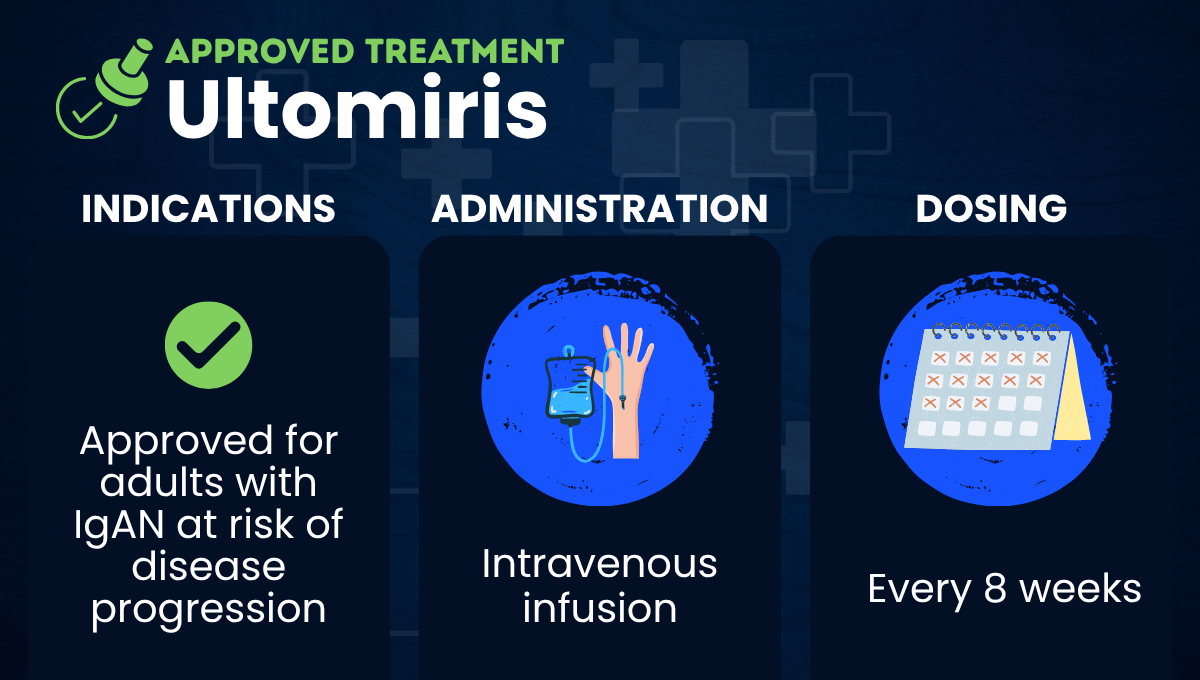
What is Ultomiris for immunoglobulin A nephropathy?
Ultomiris (ravulizumab) is a complement inhibitor with accelerated approval in the U.S. for adults with immunoglobulin A nephropathy (IgAN) who are at risk of disease progression. Regulators based this approval on data showing Ultomiris can reduce excess protein in urine (proteinuria), a sign of kidney damage in IgAN.
IgAN occurs when immune complexes containing an abnormal version of the immunoglobulin A (IgA) antibody accumulate in the kidneys. These deposits activate immune pathways, including one called the complement cascade, that contribute to kidney inflammation and damage.
Ultomiris is designed to counteract this excessive immune activity by inhibiting the complement cascade. It does so by blocking an important step in the complement signaling pathway: the split of the C5 protein into two inflammation-promoting components. Stopping that split is expected to reduce inflammation and kidney damage, and may ease symptoms of IgAN.
Alexion, the rare disease unit of AstraZeneca, markets the medication as an into-the-vein (intravenous) infusion. Other approved indications of Ultomiris include the complement-related conditions generalized myasthenia gravis, neuromyelitis optica spectrum disorder, atypical hemolytic uremic syndrome, and paroxysmal nocturnal hemoglobinuria.
| Brand name | Ultomiris |
| Chemical name | Ravulizumab |
| Usage | Used to reduce proteinuria in adults with IgAN at risk of disease progression |
| Administration | Intravenous infusion |
Who with IgAN can take Ultomiris?
In the U.S., Ultomiris has accelerated approval for adults with primary IgAN — meaning the disease isn’t related to another underlying condition — who are at risk of disease progression.
This early form of approval is based on preliminary clinical trial results showing the therapy reduces proteinuria in people with IgAN. It has not been established whether the medication slows the decline in kidney function. Full approval will require additional clinical trial data verifying its clinical benefit.
People with serious, unresolved infections caused by Neisseria meningitidis, the bacterium that causes meningococcal disease, should not start taking Ultomiris.
The medication carries a boxed warning that it increases the risk of serious or life-threatening infections from N. meningitidis. For that reason, it is available only through a restricted-access program called the Ultomiris and Soliris Risk Evaluation and Mitigation Strategy, which outlines vaccine requirements for treatment eligibility.
How is Ultomiris administered in IgAN?
Ultomiris is available as an intravenous infusion, with dosing based on body weight. When starting treatment, patients first receive a single loading dose. Two weeks later, they begin receiving maintenance infusions every eight weeks.
The infusions are administered by a healthcare provider. This is usually done at an infusion center or doctor’s office, but some people may be eligible to receive infusions at home.
The duration of an infusion varies with body weight and a patient’s response to treatment, but is typically less than one hour.

Ultomiris in IgAN clinical trials
Accelerated approval of Ultomiris in the U.S. is largely supported by interim data from a Phase 3 trial called I CAN (NCT06291376). The interim analysis included data from 352 participants who had received Ultomiris or a placebo in addition to standard-of-care IgAN treatments for 34 weeks, or nearly eight months. The data showed:
- Ultomiris led to a significant 43.4% reduction in urinary protein-to-creatinine ratio — a measure of proteinuria — compared with the placebo after 34 weeks, with reductions seen as early as 10 weeks into treatment
- Results were consistent across participant subgroups, including by race, geographical region, age, sex, and initial kidney function
- Among participants who did not have blood in their urine, a potential sign of kidney injury, at the start of the trial, the development of this symptom was significantly less common with Ultomiris than with the placebo at week 34
I CAN participants will continue on their assigned therapy for a total of slightly longer than two years. The final analysis, which could support full approval of Ultomiris for IgAN, will focus on changes in estimated glomerular filtration rate (eGFR), a measure of kidney function.
A smaller Phase 2 trial called SANCTUARY (NCT04564339) previously showed that Ultomiris led to significant reductions in urinary protein compared with a placebo after about six months. The treatment was also associated with stabilization of eGFR values, compared with a decline among those given a placebo.
Alexion is also sponsoring a Phase 3 trial (NCT07024563) to test Ultomiris in children and adolescents with IgAN.
Ultomiris side effects
The most common side effect of Ultomiris among people with IgAN is upper respiratory tract infection.
According to the boxed warning, patients should be vaccinated against meningococcal disease at least two weeks before starting treatment, unless the risks of delaying treatment outweigh the risks of a serious infection. Unvaccinated people should receive preventive antibiotics until they can be vaccinated.
Even with vaccination, serious infections are still possible. Patients should be closely monitored for signs and symptoms of a meningococcal infection. Caution should also be used when administering Ultomiris to someone with any other type of systemic infection.
Some people receiving Ultomiris may experience infusion-related reactions. Patients will be monitored during infusions, and if serious reactions develop, the infusion may be interrupted to administer treatment.
IgA Nephropathy News is strictly a news and information website about the disease. It does not provide medical advice, diagnosis, or treatment. This content is not intended to be a substitute for professional medical advice, diagnosis, or treatment. Always seek the advice of your physician or other qualified health provider with any questions you may have regarding a medical condition. Never disregard professional medical advice or delay in seeking it because of something you have read on this website.