
Povetacicept for immunoglobulin A nephropathy
 Fact-checked by
What is povetacicept for IgA nephropathy?
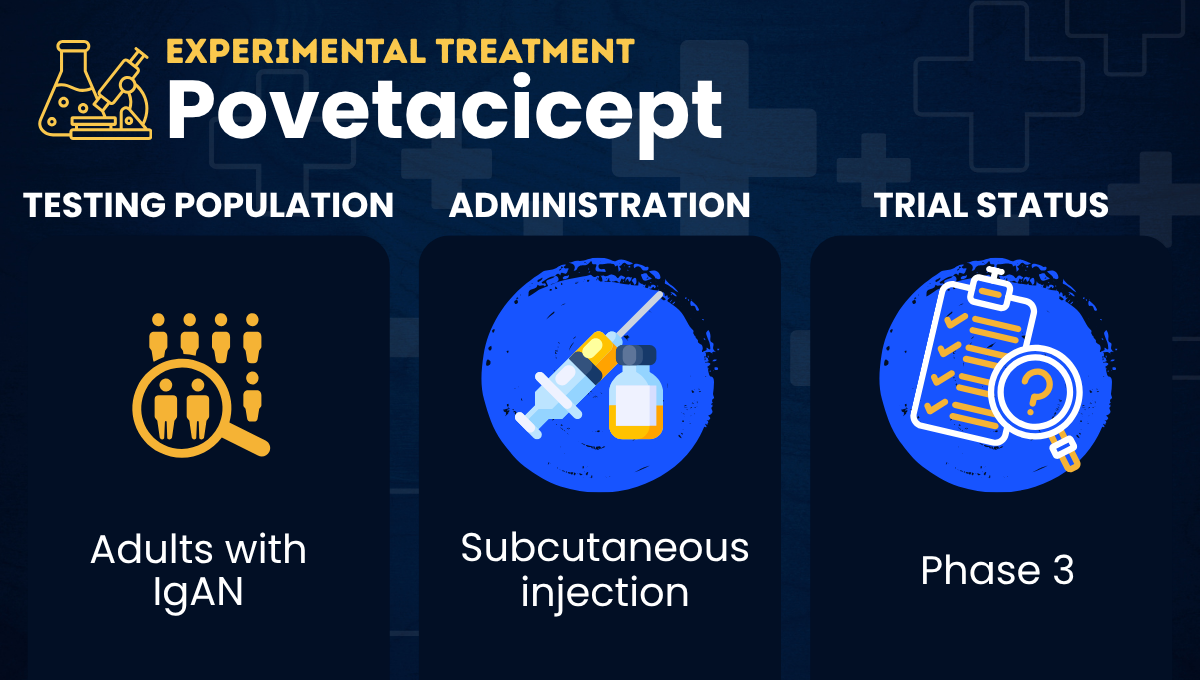
Povetacicept is an injection therapy being tested as a potential treatment to help ease kidney-related symptoms in immunoglobulin A nephropathy (IgAN).
People with IgAN produce an abnormal version of the immunoglobulin A (IgA) antibody called galactose-deficient IgA1 (Gd-IgA1). This antibody forms complexes that accumulate in the kidneys, triggering a damaging immune response.
While researchers aren’t certain why Gd-IgA1 production occurs in IgAN, they believe that two signaling molecules — A proliferation-inducing ligand, known as APRIL, and B-cell activating factor, called BAFF — may contribute to this process. Specifically, APRIL and BAFF may help activate plasma cells, the immune cells that produce Gd-IgA1.
By inhibiting both APRIL and BAFF, povetacicept aims to reduce Gd-IgA1 levels and ease IgAN symptoms, such as excessive protein in urine, called proteinuria. The treatment candidate is being tested as a subcutaneous, or under-the-skin, injection, given monthly.
Vertex Pharmaceuticals is developing povetacicept for IgAN as well as two other autoimmune conditions, namely, generalized myasthenia gravis and primary membranous nephropathy. Based on early results of an ongoing Phase 3 trial, povetacicept for IgAN is now under regulatory review in the U.S., with a decision expected by the end of November 2026.
Therapy snapshot
| Treatment name | Povetaciept |
| Administration | Subcutaneous injection |
| Clinical testing | In Phase 3 testing for IgAN |
How will povetacicept be administered in IgAN?
A Phase 3 clinical trial is testing povetacicept as a subcutaneous injection (80 mg) administered every four weeks.
If povatacicept receives regulatory approval, Vertex plans to sell the medication in ready-to-use autoinjectors that could be administered at home with an injection time of less than 1.5 seconds.
Povetacicept in IgAN clinical trials
Povetacicept has been tested in two main clinical trials involving adults with IgAN: a Phase 1/2 study dubbed RUBY-3 (NCT05732402) and the also-ongoing Phase 3 trial RAINIER (NCT06564142). Both are expected to wrap up in 2028.
Each study was designed to evaluate changes in urinary protein-to-creatinine ratio (UPCR), a measure of proteinuria, and estimated glomerular filtration rate (eGFR), a metric of kidney function:
- In RUBY, 54 participants with IgAN received monthly injections of povetacicept (80 mg or 240 mg) for nearly one year. Those in the 80 mg group had an average 64% decrease in UPCR, indicating a reduction in proteinuria, data show. Levels of Gd-IgA1 declined by 77%, while eGFR stayed relatively stable. Results with the 240 mg dose were largely similar.
- RANIER involves 605 adults with IgAN who are receiving monthly povetacicept (80 mg) or a placebo for two years. Interim results at week 36, or about the nine-month mark, showed that povatacicept was associated with a nearly 50% reduction in UPCR relative to the placebo, as well as a nearly 80% reduction in Gd-IgA1 levels. Among participants who started the study with blood in their urine, 85% in the treatment group had this clinical sign resolve, compared with 23% of those on the placebo.
The interim findings from RANIER formed the basis of Vertex’s application seeking accelerated approval of povetacicept for IgAN. Accelerated approval allows a therapy to be conditionally marketed based on promising early results. Meanwhile, RAINIER will continue, with the goal of evaluating eGFR changes after two years.
Povetacicept side effects
In the first 36 weeks of the RAINIER trial, the most common side effects of the therapy were:
- upper respiratory tract infection
- the common cold
- injection site reactions
Povetacicept was also generally safe and well tolerated in RUBY-3. There were no serious side effects related to the drug.
IgA Nephropathy News is strictly a news and information website about the disease. It does not provide medical advice, diagnosis, or treatment. This content is not intended to be a substitute for professional medical advice, diagnosis, or treatment. Always seek the advice of your physician or other qualified health provider with any questions you may have regarding a medical condition. Never disregard professional medical advice or delay in seeking it because of something you have read on this website.