
Mezagitamab for immunoglobulin A nephropathy
 Fact-checked by
What is mezagitamab for IgAN?
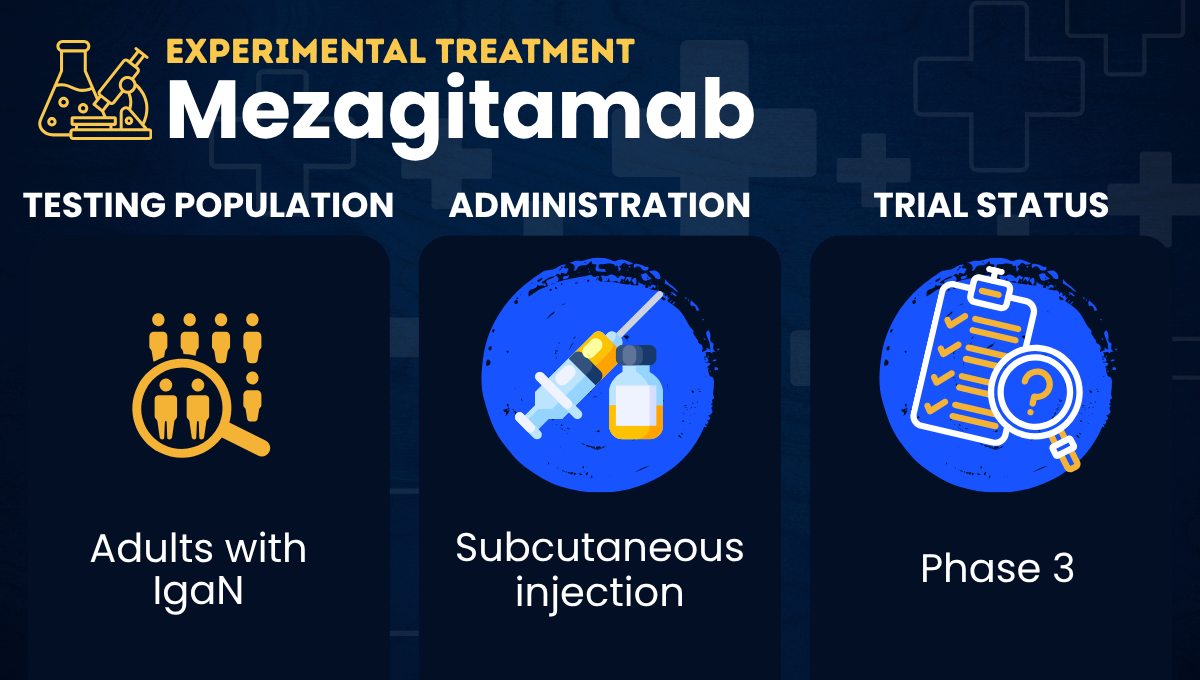
Mezagitamab is an experimental antibody-based therapy in clinical testing as a treatment for immunoglobulin A nephropathy (IgAN).
People with IgAN produce an abnormal antibody called galactose-deficient IgA1 (Gd-IgA1). It forms complexes with other immune proteins, which then deposit in the kidneys. There, the complexes set off an immune process that ultimately leads to signs and symptoms of kidney damage, including excessive protein in urine (proteinuria). Researchers believe that immune cells called plasma cells produce Gd-IgA1, although it isn’t clear what triggers them to do so.
Mezagitamab is designed to target these antibody-producing plasma cells. It contains an antibody that binds to CD38, a protein that plasma cells have on their surface, which triggers the cells’ destruction by the immune system. By depleting plasma cells, the therapy is expected to lower production of Gd-IgA1, in turn helping to protect the kidneys.
Developer Takeda is sponsoring ongoing trials to test mezagitamab — formulated as an under-the-skin (subcutaneous) injection — in people with IgAN. It hopes to seek regulatory approval of the therapy for IgAN in 2027 or 2028. The company is also developing mezagitamab for other immune-mediated conditions, including immune thrombocytopenia and antibody-mediated organ rejection after kidney transplant.
Therapy snapshot
| Treatment name | Mezagitamab |
| Administration | Subcutaneous injection |
| Clinical testing | Currently in Phase 3 testing for IgAN |
How will mezagitamab be administered in IgAN?
Clinical trials have tested mezagitamab as a subcutaneous injection. Dosing is designed to occur over a limited period, with effects lasting after treatment ends.
In an ongoing Phase 3 trial, participants are receiving 16 doses of mezagitamab over 22 weeks, but will be monitored for long-term treatment effects after that. The exact dose being tested has not been publicly announced.
Mezagitamab in IgAN clinical trials
The ongoing Phase 3 AMiGA trial (NCT06963827) is testing mezagitamab against a placebo in about 347 adults with IgAN, who will be treated for 22 weeks (about five months) and then monitored for an additional 82 weeks, or a little over 1.5 years.
AMiGA’s main goal is to assess the change in urinary protein-to-creatinine ratio (UPCR), which measures proteinuria, at 36 weeks (a little over eight months). Other outcomes of interest include estimated glomerular filtration rate (eGFR), a metric of kidney function, which will be assessed after one and two years.
The Phase 3 study’s launch was supported by data from a Phase 1b clinical trial (NCT05174221). It included 17 adults with IgAN who received mezagitamab for about six months — weekly for the first eight weeks and every other week for the next 16 — and were then followed at least up to week 48 (nearly a year), with some followed up to week 96 (nearly two years). Results demonstrated:
- UPCR decreased by a mean of 54.1% after nearly a year (48 weeks), reflecting an easing of proteinuria, which was generally sustained through long-term follow-up
- eGFR stayed relatively stable throughout the entire study
- levels of Gd-IgA1 decreased by 57.8% over 48 weeks, with reductions largely sustained up to 96 weeks
- of participants who started the study with blood in their urine (hematuria), a potential sign of kidney damage, 60% experienced resolution by week 96
Mezagitamab side effects
There were no serious safety concerns in the Phase 1 trial of mezagitamab for IgAN, according to Takeda. However, 64.7% of participants experienced a drug-related side effect. Infections were common, but all were mild or moderate.
The most frequently reported side effects included:
- upper respiratory tract infection
- fever
- throat pain
IgA Nephropathy News is strictly a news and information website about the disease. It does not provide medical advice, diagnosis, or treatment. This content is not intended to be a substitute for professional medical advice, diagnosis, or treatment. Always seek the advice of your physician or other qualified health provider with any questions you may have regarding a medical condition. Never disregard professional medical advice or delay in seeking it because of something you have read on this website.