
Trutakna (atacicept-vymj) for immunoglobulin A nephropathy
 Fact-checked by
What is Trutakna for immunoglobulin A nephropathy?
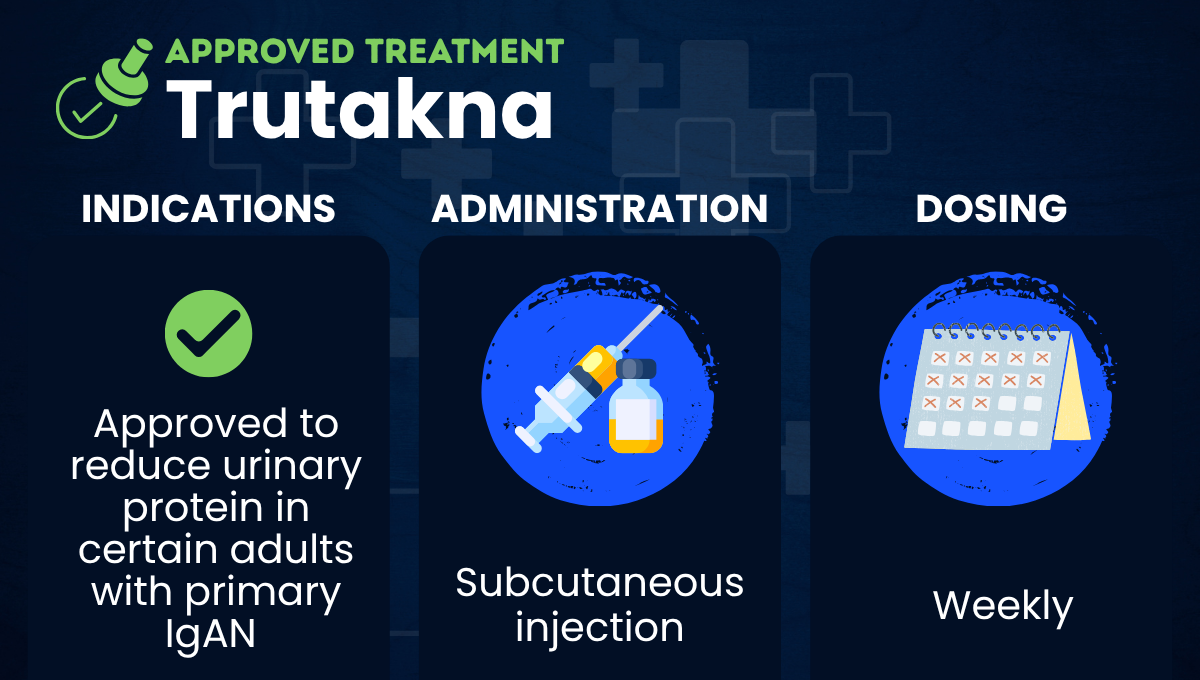
Trutakna (atacicept-vymj) is an injection therapy that is used to treat adults with immunoglobulin A nephropathy (IgAN) who are at a high risk of disease progression. The medication holds accelerated approval in the U.S. based on its ability to lower elevated levels of protein in the urine (proteinuria), a sign of kidney dysfunction, in such individuals.
IgAN is characterized by the accumulation of immune complexes containing an abnormal type of antibody called galactose-deficient immunoglobulin A1 (Gd-IgA1) in the kidneys. As Gd-IgA1 builds up, it triggers inflammation and damage to the kidneys.
While researchers do not fully understand why people with IgAN produce Gd-IgA1, they believe the process may be related to signals from two immune messenger molecules — A proliferation-inducing ligand (APRIL) and B-cell activating factor (BAFF).
Trutakna, given via under-the-skin (subcutaneous) injections, is designed to block the activity of APRIL and BAFF, which may decrease Gd-IgA1 production and protect the kidneys from harm. This has been shown to ease proteinuria, suggesting a reduced risk of kidney complications.
Developer Vera Therapeutics is sponsoring trials to confirm that Trutakna slows long-term kidney decline in people with IgAN. Successful trial results could support Vera’s application for full approval of Trutakna for IgAN.
| Brand name | Trutakna |
| Chemical name | Atacicept-vymj |
| Usage | Used to reduce levels of protein in urine for adults with primary IgAN |
| Administration | Subcutaneous injection |
Who can take Trutakna?
In the U.S., Trutakna is approved to reduce proteinuria in adults with primary IgAN — a form of the disease not known to be caused by another underlying condition — who are at risk of disease progression. The medication was cleared under an accelerated approval pathway based on early clinical trial data, but confirmatory evidence is needed to support full approval.
The prescribing information for Trutakna notes that it is contraindicated or not recommended for people with severe allergies to the therapy or any of its ingredients.
How is Trutakna administered?
Trutakna is given as a subcutaneous injection using a prefilled, single-dose autoinjector. After proper training, patients and caregivers can administer the injections at home. The recommended dosage is 150 mg once weekly.
Injection sites should be rotated between the abdomen and thighs. The autoinjector should be stored in the refrigerator and allowed to sit for 15 to 30 minutes at room temperature before use.

Trutakna in clinical trials
In the U.S., preliminary results from the Phase 3 ORIGIN 3 trial (NCT04716231) supported the accelerated approval of Trutakna. In the study, 376 adults with IgAN who were taking stable doses of blood pressure medications received weekly subcutaneous injections of Trutakna or a placebo for two years.
An interim analysis of 203 participants after 36 weeks (about eight months) showed:
- Trutakna decreased proteinuria significantly more than the placebo, as measured using the urinary protein-to-creatinine ratio (UPCR). While the placebo group saw an average 6.8% reduction in UPCR, the Trutakna group had a 45.7% reduction.
- Levels of Gd-IgA1 decreased by 68% with Trutakna, suggesting the medication was working as intended to limit production of these abnormal antibodies.
Results of the full trial will include all participants and two years of treatment data. The goal is to measure changes in estimated glomerular filtration rate, which reflects how efficiently the kidneys filter blood. These data could support an application for full approval of Trutakna.
In addition to the two-year randomized treatment period, ORIGIN 3 includes a yearlong open-label extension during which participants will be eligible to receive Trutakna regardless of their original assigned treatment group.
Trutakna side effects
In clinical trials, the most common side effects of Trutakna were:
- upper respiratory tract infection
- redness or other reactions at the injection site
Trutakna may suppress the production of healthy antibodies, increasing the risk of infections. Monitoring for infections before and during treatment is recommended, and doctors typically recommend against starting Trutakna during an uncontrolled infection. If a serious infection occurs while taking Trutakna, the medication may need to be paused while the infection is treated.
This treatment may also affect the safety and efficacy of certain vaccines. Live vaccines — a type of immunization that contains a live but weakened form of a virus or bacterium — are not recommended within 30 days of starting Trutakna or at any time while taking the medication.
IgA Nephropathy News is strictly a news and information website about the disease. It does not provide medical advice, diagnosis, or treatment. This content is not intended to be a substitute for professional medical advice, diagnosis, or treatment. Always seek the advice of your physician or other qualified health provider with any questions you may have regarding a medical condition. Never disregard professional medical advice or delay in seeking it because of something you have read on this website.