
Fabhalta (iptacopan) for immunoglobulin A nephropathy
 Fact-checked by

What is Fabhalta for immunoglobulin A nephropathy?
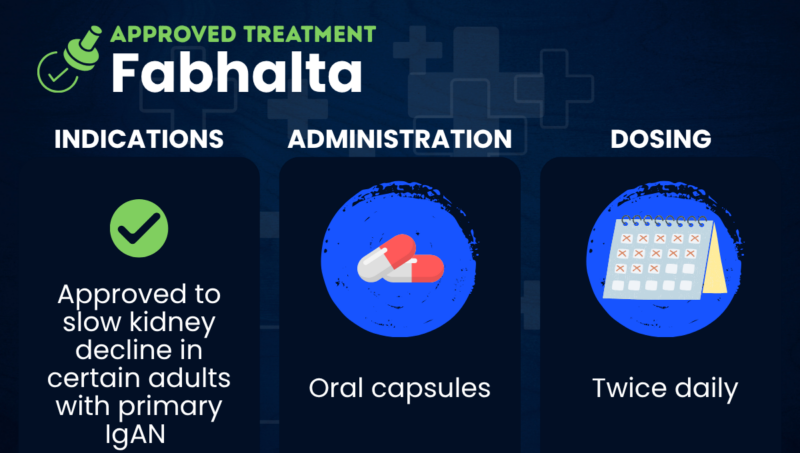
Fabhalta (iptacopan) is an approved oral therapy used to preserve kidney function in adults with immunoglobulin A nephropathy (IgAN) who are at risk of disease progression.
In IgAN, immune complexes containing abnormal versions of the immunoglobulin A (IgA) antibody accumulate in the kidneys. There, they activate a variety of immune processes, ultimately leading to inflammation and kidney injury. The complement cascade, a part of the immune system, is thought to contribute to kidney damage in IgAN.
The complement cascade involves several blood proteins that are sequentially activated in a chain reaction to drive immune activity. Fabhalta is designed to block this system by targeting factor B, a complement protein that works early in the signaling cascade to activate other complement proteins. By blocking this chain of events, Fabhalta is expected to help control abnormal immune activity and slow kidney declines.
Novartis is the developer of Fabhalta. The medication is also approved in the U.S. for certain adults with other complement-mediated diseases, including paroxysmal nocturnal hemoglobinuria and complement 3 glomerulopathy.
| Brand name | Fabhalta |
| Chemical name | Iptacopan |
| Usage | Used to slow loss of kidney function in adults with primary IgAN |
| Administration | Oral capsules |
Who can take Fabhalta?
In the U.S., Fabhalta is approved for adults with primary IgAN — meaning the disease does not have a known underlying cause — who are at risk of disease progression.
Fabhalta is contraindicated, or not recommended, for people with:
- serious allergies to Fabhalta or its ingredients.
- serious, unresolved infections caused by encapsulated bacteria, such as Streptococcus pneumoniae, Neisseria meningitidis, or Haemophilus influenzae type b.
Encapsulated bacteria have a protective coating to help shield them from the body’s immune system. The prescribing information carries a boxed warning noting that Fabhalta’s immune-suppressing activity can increase the risk of serious or life-threatening infections caused by these bacteria. As such, the medication is available only through a Risk Evaluation and Mitigation Strategy program, which imposes certain vaccination and monitoring requirements.
How is Fabhalta administered?
Fabhalta is available as oral capsules, with a recommended dose of one 200 mg capsule taken twice daily. The capsules should be swallowed whole without breaking, crushing, or chewing them, and may be taken with or without food.
Fabhalta in clinical trials
The Phase 3 APPLAUSE-IgAN trial (NCT04578834) provided the data that supported Fabhalta’s approval for IgAN in the U.S. It involved 477 adults with IgAN who were at a high risk of disease progression despite stable doses of standard blood pressure medications. They received either Fabhalta or a placebo twice daily, on top of their existing regimen, for two years.
The main goal was to evaluate changes in urinary protein-to-creatinine ratio (UPCR). A higher UPCR indicates excess protein in the urine (proteinuria), a marker of kidney dysfunction. Investigators also assessed the estimated glomerular filtration rate (eGFR), which indicates how well the kidneys are filtering blood.
- A prespecified interim analysis of 250 participants after nine months showed that UPCR decreased, on average, by 38.3% with Fabhalta compared with the placebo, reflecting a significantly greater reduction in proteinuria. This change was sustained for the remainder of the trial [see PI].
- In another analysis that included the full two-year trial period and all participants, the decline in eGFR was significantly slower among those treated with Fabhalta than those on the placebo, reflecting slower declines in kidney function.
- Fabhalta significantly decreased the likelihood of experiencing kidney failure, defined using a variety of metrics, relative to the placebo.
An ongoing open-label extension study (NCT04557462), is testing the long-term safety and efficacy of Fabhalta among participants from APPLAUSE-IgAN and other trials. Novartis is also sponsoring a Phase 3 trial (NCT06994845) to evaluate the safety and efficacy of Fabhalta in children and adolescents with IgAN, ages 2 to 17.
Fabhalta side effects
The most common side effects of Fabhalta in adults with IgAN include:
- abdominal pain
- dizziness
According to the boxed warning, encapsulated bacterial infections can become rapidly life-threatening in people treated with complement inhibitors such as Fabhalta. Patients should be vaccinated against certain encapsulated bacterial infections at least two weeks before the first dose. If urgent treatment is needed before vaccination can be completed, doctors will prescribe preventive antibiotics, and the vaccine should be given as soon as possible.
Vaccinations don’t eliminate the risk of infections, so even vaccinated patients need to be monitored carefully for signs and symptoms of serious infection. If one develops, patients should seek immediate care. Fabhalta may need to be paused while the infection is treated.
Levels of cholesterol and other fats (triglycerides) in the blood may increase with Fabhalta. This will be monitored periodically and treated as appropriate.
Fabhalta can interact with other medications, including those that affect the activity of an enzyme called CYP32C8. Some of these medications may not be recommended for use alongside Fabhalta, or will require careful monitoring. Patients should tell their care team about all medications they are using.
IgA Nephropathy News is strictly a news and information website about the disease. It does not provide medical advice, diagnosis, or treatment. This content is not intended to be a substitute for professional medical advice, diagnosis, or treatment. Always seek the advice of your physician or other qualified health provider with any questions you may have regarding a medical condition. Never disregard professional medical advice or delay in seeking it because of something you have read on this website.